
Quality and Food Safety Policy
IVS Annex 1 · Edition 4 · 5 May 2026
About UAB Alkepa
UAB Alkepa specialises in producing and supplying alternative desserts throughout Lithuania and abroad. The company offers innovative products that meet the needs of modern consumers: gluten-free, naturally sweetened, dairy-free, egg-free, suitable for vegans and made from natural ingredients.
The company has implemented an integrated quality and food safety management system that meets the following international standards:
- ISO 22000:2018
- ISO/TS 22002-1:2009 (transitioning to ISO 22002-1:2025 + ISO 22002-100:2025);
- FSSC 22000 — certified to v6; transition to v7 is underway according to the transition plan, with all v7 requirements to apply no later than 1 January 2027;
- BRCGS Gluten-Free, v4.
- Rainforest Alliance Certified Standard
These standards help ensure the highest requirements for quality, safety, sustainability and responsible business practices throughout the supply chain, from selecting raw materials to delivering the finished product to consumers.
Our vision for the future
The management of UAB Alkepa pursues continuous growth and improvement, and therefore plans to further modernise production processes, introduce advanced technologies and improve product quality and consumer satisfaction.
Our commitments
The management and employees of UAB Alkepa follow an integrated quality and food safety policy whose provisions support operational stability, the company’s competitiveness and social responsibility.
Objectives and priorities
Improving operations and product quality
UAB Alkepa commits to:
- Continuously improving operational processes and product quality in accordance with ISO 22000:2018, FSSC 22000 (v6, transitioning to v7), BRCGS Gluten-Free v4 and Rainforest Alliance standards;
- Ensuring that products meet all requirements of Lithuanian and EU legislation, regulatory documents and customers.
- Ensuring the quality and safety of manufactured products throughout the supply chain, from receiving raw materials to providing the finished product to the consumer: meeting legislative requirements, the requirements of the certified ISO 22000:2018, FSSC 22000, BRCGS Gluten-Free v4 and Rainforest Alliance standards, and customer requirements; carrying out all operations responsibly according to approved procedures; manufacturing to approved specifications without GMOs or ingredient substitutes; and selecting suppliers and raw materials in accordance with requirements.
- Carrying out all processes responsibly, in accordance with approved procedures and specifications.
- Ensuring that the integrated policy and all processes, documented and undocumented, are known to the relevant employees and applied consistently. Ensuring that the policy and all requirements are understood and implemented, supported by clear, measurable objectives whose implementation is reviewed and evaluated so that the management system remains effective.
- Continuously improving the integrated management system, ensuring that product and process requirements are met and allocating the necessary resources. Systematically establishing strategic and operational objectives for improving the management system and assigning them to responsible employees. Ensuring that objectives are monitored and implemented efficiently and effectively. Specific measurable quality and food safety objectives are documented in a separate annual annex, “Objectives and monitoring” (document 0_FR_02).
Meeting consumer and customer needs
- Analysing and taking account of partners’ and customers’ expectations;
- Ensuring that products and services meet the highest quality and safety requirements.
- Ensuring that product labelling complies with the legislation and regulations of the destination country (the intended market), including allergen declarations and customer-specific requirements.
- Ensuring effective external communication on food safety and quality with suppliers, customers, consumers and public authorities: exchanging timely information on product safety, allergens, changes, complaints and incidents, including product recalls.
- Communicating transparently and promptly, within 3 working days, with the certification body about serious events affecting the management system or the integrity of the certificate.
Social responsibility and sustainability
- Developing the business in accordance with the principles of social responsibility and environmental protection;
- Implementing pollution prevention measures and reducing environmental impact;
- Using natural resources responsibly and contributing to climate change mitigation.
- Reducing, or at least maintaining current levels of food loss and waste (FLW), taking the technological production process into account, in production and throughout the supply chain, by setting measurable objectives and deadlines in line with UN Sustainable Development Goal SDG 12.3 and FSSC 22000 V7 requirement 2.5.16.
- Applying sustainable packaging principles (Save Food Packaging, AIP/WPO) when designing and selecting packaging: protecting the product, extending shelf life, reducing food loss and communicating clearly with consumers.
- Ensuring compliance with applicable EU regulations: PPWR (Packaging and Packaging Waste Regulation, EU 2025/40) and EUDR (EU Deforestation Regulation, EU 2023/1115), in the cocoa and coffee raw material supply chain.
Human rights and working conditions
- Operating responsibly and ethically in accordance with the OECD Due Diligence Guidance for Responsible Business Conduct and the UN Guiding Principles on Business and Human Rights.
- Respecting the rights of all employees in accordance with international human rights standards.
- Ensuring gender equality and tolerating no gender discrimination. Providing women and men with equal opportunities for employment, development and equal recognition.
- Tolerating no forced labour, child labour or discrimination.
- Ensuring safe and healthy working conditions.
- Requiring suppliers and partners to follow the same principles, setting these expectations out in supply agreements, purchasing terms or a supplier code of conduct.
Employee engagement and competence
- Systematically, effectively and promptly informing employees about the operation, effectiveness, results, efficiency, compliance and changes of the integrated management system; its benefits and importance; each employee’s role and contribution; and employees’ work ethics and responsibility to comply with requirements and fulfil assigned objectives and tasks.
- Continuously strengthening and developing employees’ commitment to food quality and food safety, building an appropriate food quality and safety culture, and encouraging ethical and responsible conduct in operations, relationships and communication with other stakeholders. Food safety and quality culture objectives, the plan and the report are documented separately (IVS_F8, “Food safety culture model, plan and report”).
- Systematically developing employees’ competence in quality and food safety to ensure their active and effective involvement in the operation of the management system.
Risk management and product protection
- Ensuring protection against food defence threats and food fraud risks;
- Continuously reviewing and strengthening the effectiveness of the management system.
Efficiency and innovation
- Responding flexibly to a changing environment and market needs;
- Expanding the product range and strengthening competitive advantage;
- Systematically establishing strategic objectives and monitoring their implementation and operational results.
Policy implementation
The management of UAB Alkepa commits to:
- Providing the resources needed to implement the management system policy;
- Continuously monitoring and reviewing the effectiveness of the management system;
- All employees must comply with the policy and work towards achieving their assigned objectives.
Management invites all employees to contribute to achieving these objectives and ensures that the policy is applied consistently throughout the company’s activities.
Regular review and improvement
The policy of UAB Alkepa is reviewed at least once a year or when legal or operational requirements change, to ensure that it remains relevant, effective and aligned with the company’s strategic objectives. All relevant parties are informed of significant updates.
Management responsibility
Management is responsible for implementing and reviewing this policy, staff training and internal communication.
Director Raimondas Zabiela
Food safety
Quality we care about.
 BRCGS Gluten-Free
 FSSC 22000
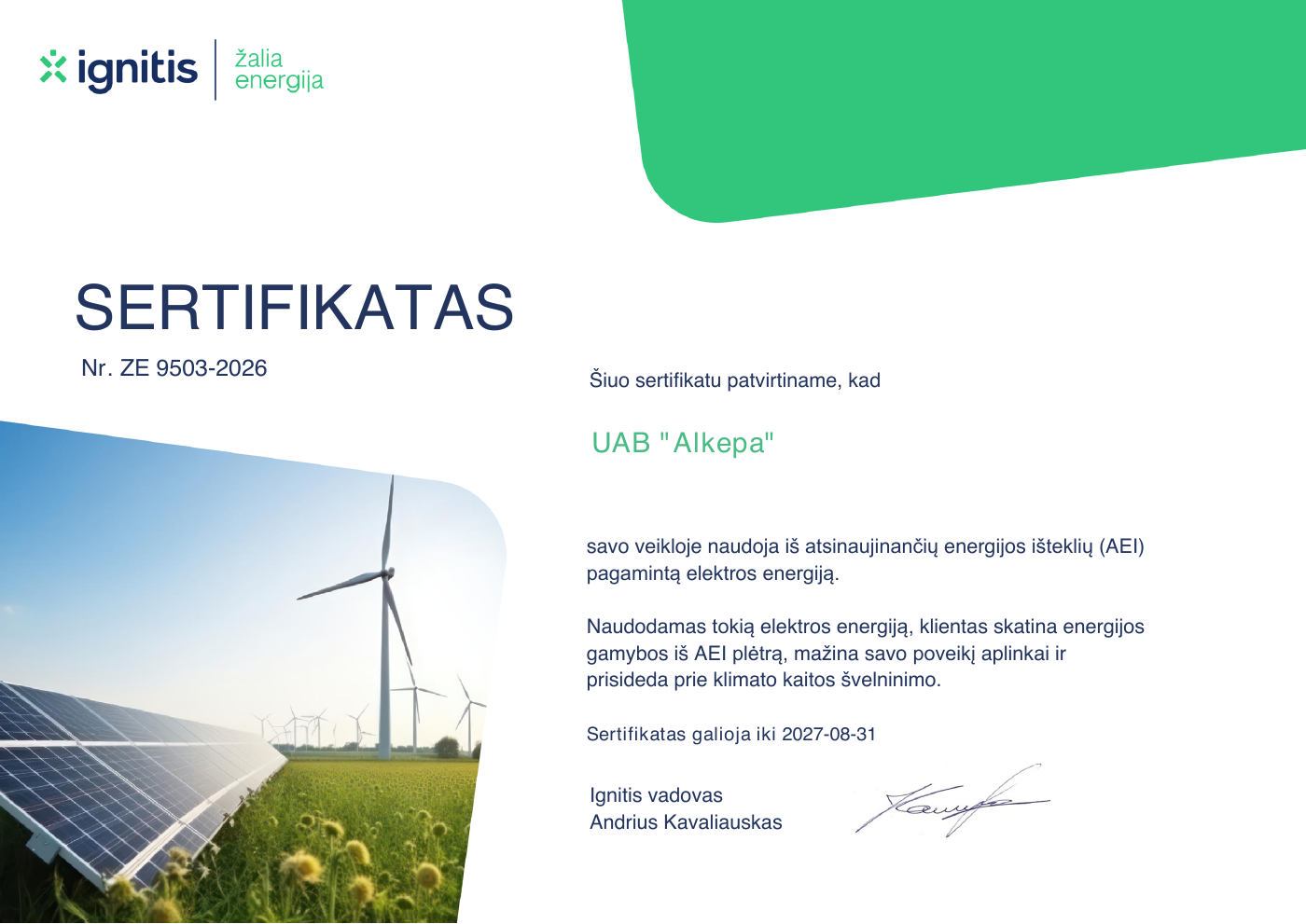
Renewable energy
Green energy in our operations.
Ignitis certifies that UAB Alkepa uses electricity generated from renewable energy sources.
Certificate No. ŽE 9503-2026 · Valid until 31 August 2027.
Download certificate (PDF) ↗